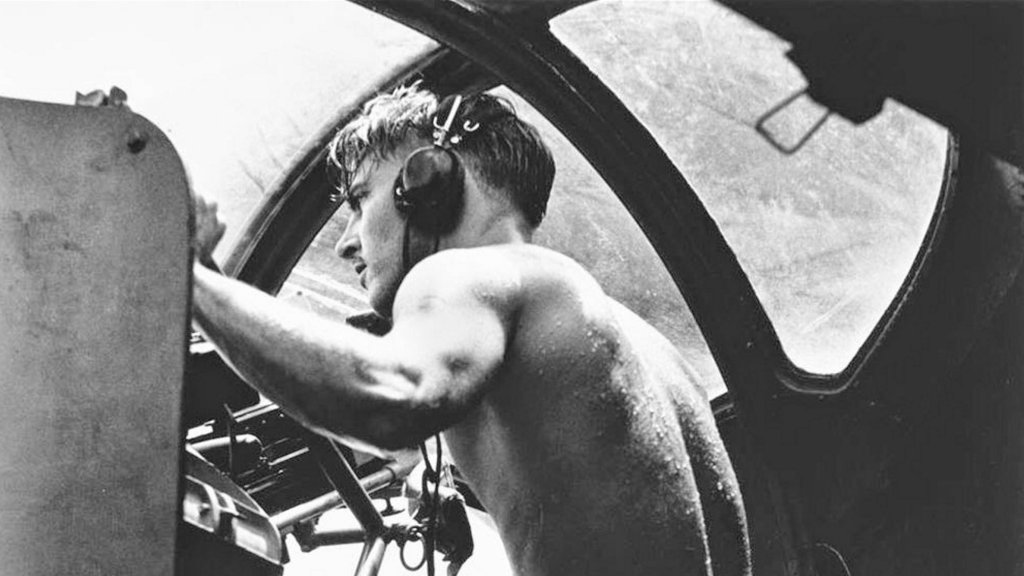
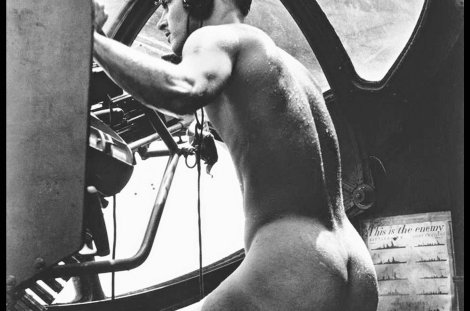
A naked man at a machine gun: at first glance, the world-famous photograph “PBY Blister Gunner, Rescue at Rabaul” seems an unusual, almost disconcerting image. Yet behind it lies a dramatic story of war, rescue and extraordinary courage. The photograph was taken in April 1944 by the legendary photojournalist Horace Bristol. It shows a completely naked US Navy gunner at his station in the so-called “blister”, the transparent gun turret on an aircraft’s fuselage – immediately after a life-threatening rescue operation in the South Pacific. The image has been widely reproduced and is now regarded as a symbol of courage, loyalty and a particular form of male physicality. It is precisely this combination of military heroism and the exposed depiction of a young, athletic male body that continues to give the photograph a homoerotic tension. The naked body is not detached from the serious story behind it, but stands in contrast to it: vulnerability and strength meet.
Rescue under Japanese fire
The setting was Rabaul Harbour in what is now Papua New Guinea – a heavily fortified key base for the Japanese military during the Second World War. The mission began after US naval aviator Lieutenant Robert A. Schaeffer was shot down in his F4U Corsair over the St. Georges Channel. After hours in the water, the pilot was badly burnt, exhausted and temporarily blinded. A twin-engined US Navy Consolidated PBY “Catalina” amphibious aircraft with the call sign “Dumbo” then landed in enemy waters to rescue the pilot. But the situation was extremely dangerous: Japanese coastal batteries and soldiers on the island opened fire on the rescue aircraft and the pilot in the water. The young gunner realised that swift action was necessary. His heavy uniform and waterlogged boots would have hindered him while swimming and possibly put his own life at risk. So he quickly stripped naked, jumped into the water, reached the injured pilot and successfully brought him back aboard the PBY.
After the rescue, however, there was no time to get dressed again. The aircraft had to take off immediately to escape enemy fire. The naked serviceman therefore returned straight to his machine gun in the “blister” to protect the aircraft during take-off. In this moment of extreme tension, with the adrenaline of the danger just survived still surging, Horace Bristol pressed his camera’s shutter. While the identity of the rescued pilot, Robert A. Schaeffer, is documented in military records held in the US National Archives, the naked gunner’s name was never officially made public. Horace Bristol himself never named the man during his lifetime. The serviceman thus remained one of the most famous unsolved mysteries in the photographic history of the Second World War. A possible new lead later came from the Air Force Museum of New Zealand. Researchers discovered a letter Bristol had written in 1993 to the New Zealand embassy in Washington. In it, the photographer suggested that the gunner might have been a New Zealand serviceman, as American and New Zealand units worked closely together in the South Pacific. The museum’s report is entitled “Kiwi Connection: The Naked Gunner of Rabaul”.
Photographer of contemporary history
Through his camera, Horace Bristol documented much of the history of the 20th century. His photographs appeared extensively in LIFE Magazine during the 1930s. His powerful portraits of migrant workers in California’s Central Valley, created in collaboration with John Steinbeck, became particularly well known. These works later inspired Steinbeck’s novel “The Grapes of Wrath” and established Bristol as one of the most important photographers of his time. Following the Japanese attack on Pearl Harbor, Bristol joined an elite team of naval photographers led by Edward Steichen in 1941. The group documented major theatres of war, including the invasions of North Africa, Okinawa and Iwo Jima. After the war, Bristol moved to Japan with his family, photographed the aftermath of the destruction there and founded the “East-West” photographic agency, which focused on changes in the Pacific region. His images were published worldwide, in Southeast Asia, Europe and the USA.
Between heroism and eroticism
Even today, the photograph’s distinctive impact lies in its inherent tension: it shows a serviceman in an extreme situation – and, at the same time, a naked male body that many viewers perceive as aesthetically pleasing and erotic. The French philosopher Georges Bataille argued that eroticism served a function by dissolving boundaries between human subjectivity and being human – a transgression that broke open the rational world: “Unlike simple sexual activity, eroticism is a psychological quest … Eroticism means assenting to life even in the face of death.” It is precisely in the face of mortal danger – the rescue of a downed pilot and the moment of “Memento Mori” captured by the photograph – that viewers can see not only danger and heroism in this image, but also a particular form of affirmation of life. The “Naked Gunner” thus remains more than a war photograph: it is an image about courage, vulnerability, masculinity – and the complex emotions that a single historical photograph can still evoke today.