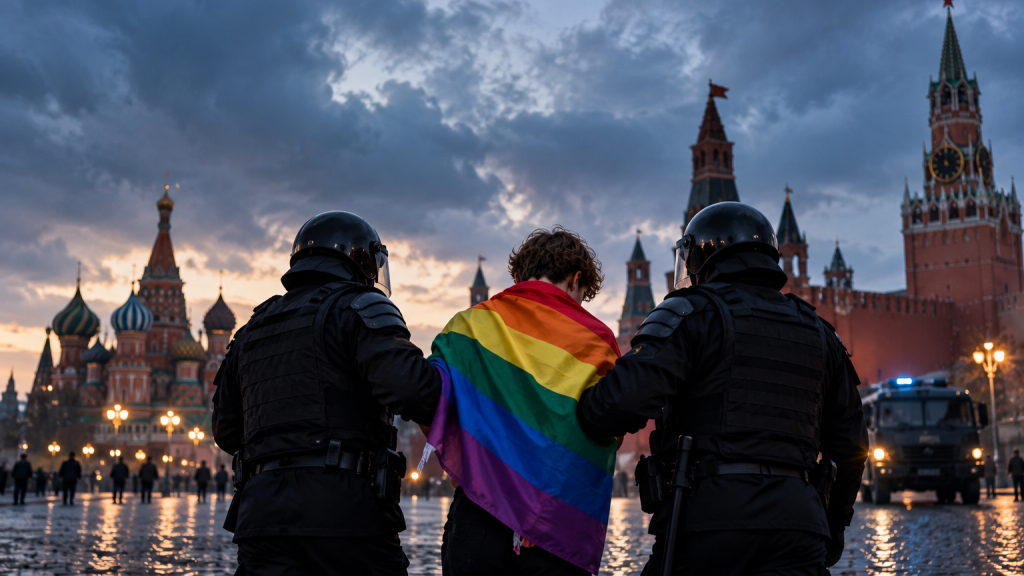
The number of proceedings over alleged “LGBT propaganda” rose significantly in Russia last year. An analysis of official judicial statistics found that a total of 285 new cases were registered in 2025. The fines imposed totalled the equivalent of around €721,000. This represents an increase of 83 per cent compared with 2024.
Key points at a glance
- Significant increase: Russian courts registered a total of 285 new proceedings relating to the so-called LGBT propaganda laws in 2025. The true figure is likely to be considerably higher.
- A total of 182 fines were imposed, worth the equivalent of around €721,000. This represents an increase of 83 per cent.
- Moscow at the centre: The capital and St Petersburg accounted for almost 90 per cent of the fines imposed.
- Further repression: Russian authorities continued to take action against LGBTQ+ activists, journalists, organisations and publications in 2026.
Sharp increase in bans
The authorities intervened particularly frequently in Moscow and St Petersburg. At the same time, the published figures show that a large proportion of the fines imposed have yet to be paid. The analysis was carried out by Jaroslaw Rasputin for the Russian news website Parni+ (German). It draws on statistics from the Judicial Department of the Supreme Court, supplemented by regional data. The Russian judiciary published the figures for 2025 only after a considerable delay. It is not possible to attribute every proceeding precisely to an individual legal provision; three laws in total cover “LGBT propaganda”. There are also substantial gaps in regional reporting. While the nationwide statistics cover all Russian courts, regional judicial authorities do not publish their data consistently. In short, the actual figures could be considerably higher still.
Most proceedings in Moscow
Complete regional statistics were therefore available from only 31 regions, including the cities of Moscow and St Petersburg. In 2025, Russian courts received 285 new cases relating to the legal provisions covered by the statistics. There were also three proceedings carried over from the previous year. Court hearings took place in a total of 275 cases. Most new proceedings were registered in Moscow. The capital’s courts alone received 123 cases. St Petersburg recorded 31. The remaining Russian regions accounted for a combined 131 proceedings. Among the regions with published data, the industrial region of Kuzbass recorded the most cases. Twelve proceedings were filed there, all of which were heard in court.
Primorye in Russia’s Far East and the Chelyabinsk region also reported comparatively high figures. Seven proceedings were registered in each region. In total, the courts imposed 186 sanctions. Only eight proceedings were discontinued during the year. Most sanctions targeted individual citizens. A total of 136 private individuals were penalised. Sanctions were also imposed on 28 organisations and 22 executives. Companies and those responsible for them were particularly frequently held liable in Russia’s two largest cities. Five foreign nationals were also penalised.
€721,000 in fines
Russian courts mainly imposed fines for the violations they established. Of the 186 sanctions in total, 182 were financial penalties. Their total value amounted to the equivalent of around €721,000. Moscow and St Petersburg accounted for almost 90 per cent of this sum. Together, the courts in the two cities imposed fines of around €627,400. Many fines remain unpaid to this day. Enforcement of the relevant provisions expanded significantly compared with the previous year. In 2024, 214 new proceedings had been registered. Last year, that figure rose to 285. This represents an increase of 33.4 per cent. The total value of the fines imposed rose even more sharply. While fines equivalent to around €393,900 were imposed in 2024, the total had reached around €721,000 in 2025. The increase was therefore 83 per cent.
Further measures in 2026
There appears to be no end in sight: according to reports by various media outlets, the intensified enforcement of Russian laws against LGBTQ+ people has continued this year. Cultural and religious publications have also been targeted by censors. Even passages about LGBTQ+ people in Pope Francis’s autobiography were censored, while books by Heated Rivalry author Rachel Reid were banned. There have also been several proceedings against individuals. Journalists at Russia’s largest LGBTQ+ news website also felt compelled to leave the country (German) after being classified as “extremists”. There have also been repeated arrests and convictions involving gay clubs, publishers and other institutions with links to the community. Numerous LGBTQ+ organisations have also been classified as “terrorist”. Russian LGBTQ+ activists continue to receive severe sentences too: most recently, gay activist Jaroslaw Sirotkin was sentenced in absentia to four years in a penal colony.








