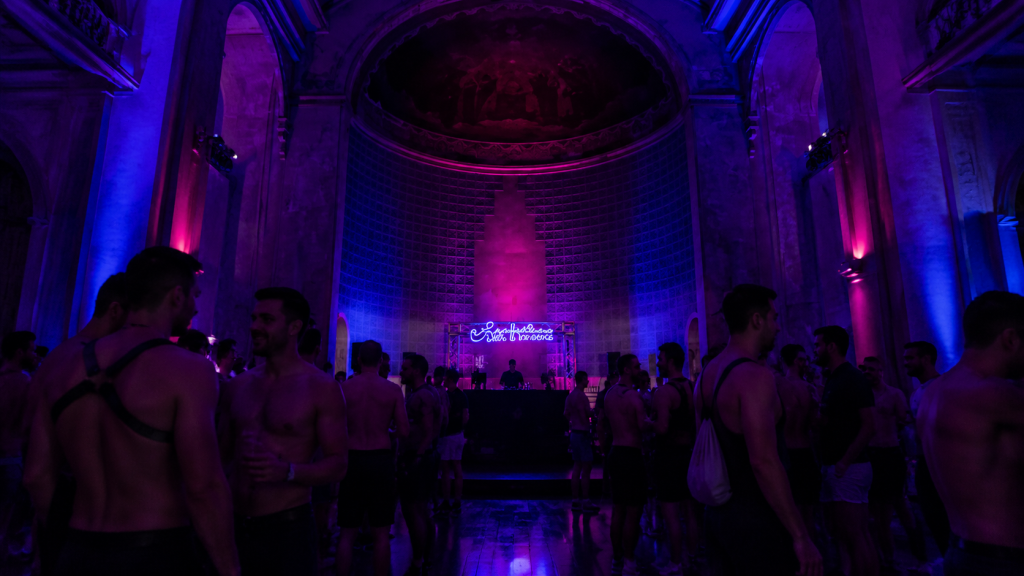
Amid historic photographs, neon lighting and electronic music, gay cruising platform Sniffies (German) celebrated the history of one of the United States’ best-known queer festivals in New Orleans. Hundreds of visitors gathered in the former church for the event “Cruising Revival: Southern Decadence Then & Now”. Afterwards, however, the unusual venue also sparked some heated debates online.
The key points at a glance
- Opening event in New Orleans: cruising platform Sniffies hosted an evening exploring the history of the queer festival Southern Decadence.
- Historic venue: hundreds of people gathered in a former church. An exhibition combined historic photographs with contemporary images from the LGBTQ+ community.
- The unusual venue sparked some heated debates on various online forums in the US.
- More than 50 years of tradition: Southern Decadence began as a private farewell party in 1973 and grew into a major queer festival in New Orleans.
- Remembering persecution and violence: a panel discussion covered topics including the 1973 arson attack on the Upstairs Lounge and current political and legislative challenges facing LGBTQ+ people in the US.
Cruising and exclusion
The evening marked the start of the celebrations surrounding the queer festival Southern Decadence. It focused on how the culture of sexual encounters between men has changed over the decades and what it means to the community. The event was not just about sexuality and nightlife. It also recalled social exclusion, political conflicts and the people who have shaped gay and queer meeting places in New Orleans across generations.
The history of Southern Decadence itself dates back to 1973. That year, friends in New Orleans organised an informal farewell party. Over more than five decades, this private gathering developed into an established city tradition and a major event for the queer community. Southern Decadence has survived numerous crises along the way. These included severe hurricanes, political disputes and the AIDS crisis, which profoundly changed the gay community in particular. Today, the festival represents a mix of street celebrations, parties, sexual self-determination and queer culture.
Exhibition about cruising
Cruising app Sniffies drew on this history for its opening event, linking the places where gay men once met with the possibilities offered by today’s digital platforms. Creative director Brett LaBauve was responsible for the event’s design. He transformed the central area of the former church building into an exhibition combining historic images with contemporary portraits. The photographs documenting cruising culture were mounted on chain-link fences illuminated by neon tubes. The installation deliberately echoed the aesthetic of public cruising spots. The fences and artificial light recalled the urban spaces where men once often met for anonymous or spontaneous encounters.
The unusual presentation created a contrast with the architecture of the former place of worship. Alongside the exhibition, the programme included music, literature and discussions. Among those taking part was writer and activist Leo Herrera, whose work explores the significance of cruising and solidarity within the community. “Cruising in its purest form is love and care for one’s neighbour, whether in a park or on a digital map,” Herrera told the audience. He drew a connection between the places where gay men once met and today’s digital possibilities.
Remembering the arson attack
A subsequent panel discussion also commemorated the 1973 arson attack on the Upstairs Lounge. On 24 June that year, a devastating fire broke out in the gay bar in New Orleans. Thirty-two people died. The crime remains one of the worst acts of violence against gay people in the history of the United States. Alongside this historic event, participants also discussed current legislative developments putting LGBTQ+ meeting places and facilities in the US under pressure. After the discussions, the focus returned to nightlife. The church’s nave became a packed dance floor. Eli Martin, the platform’s Chief Marketing Officer, said: “Cruising has always been about creating connections.”
Party in a former church
The choice of venue did, however, prompt controversy. A cruising party in a former church raises fundamental questions about the treatment of sacred spaces, particularly for religious conservatives. Online critics therefore saw the event as disrespectful towards the Christian faith and a misuse of a place originally intended for worship and prayer. In particular, the combination of sexual freedom, queer party culture and church architecture was sometimes perceived online as provocative or a desecration. Supporters, by contrast, pointed out that the Hotel Peter & Paul building is a former church no longer used for worship, which now also hosts other, secular events. They see the celebration as an expression of social openness and an opportunity to give new meaning to a space historically shaped by religion.








